


Choosing the right industrial casters is far more complicated than picking wheels that simply roll. Countless factories, warehouses, logistics workshops and manufacturing facilities face frequent breakdowns, unstable load bearing, noisy operation and unexpected safety hazards, yet most operators only judge casters by appearance and unit price. Few people realize that hidden structural defects, unsuitable material matching and unreasonable load configuration directly cause equipment damage, frequent maintenance costs and potential workplace accidents. High-performance heavy duty polyurethane industrial casters are specially designed to eliminate these long-overlooked underlying problems, supporting stable long-term operation under extreme heavy-load and frequent mobile working conditions.
Many enterprises blindly select ordinary lightweight casters for heavy machinery and large equipment handling. They do not understand the difference between static load capacity and dynamic load capacity, resulting in wheel deformation, shaft bending and bracket fracture after short-term use. Low-quality casters cannot resist ground abrasion, impact pressure and frequent steering friction, which greatly shortens overall service life. Professional customized industrial caster solutions from professional industrial caster manufacturer adopt precision forged brackets and high-density wear-resistant wheel cores, fundamentally avoiding premature aging and damage caused by mismatched load standards.
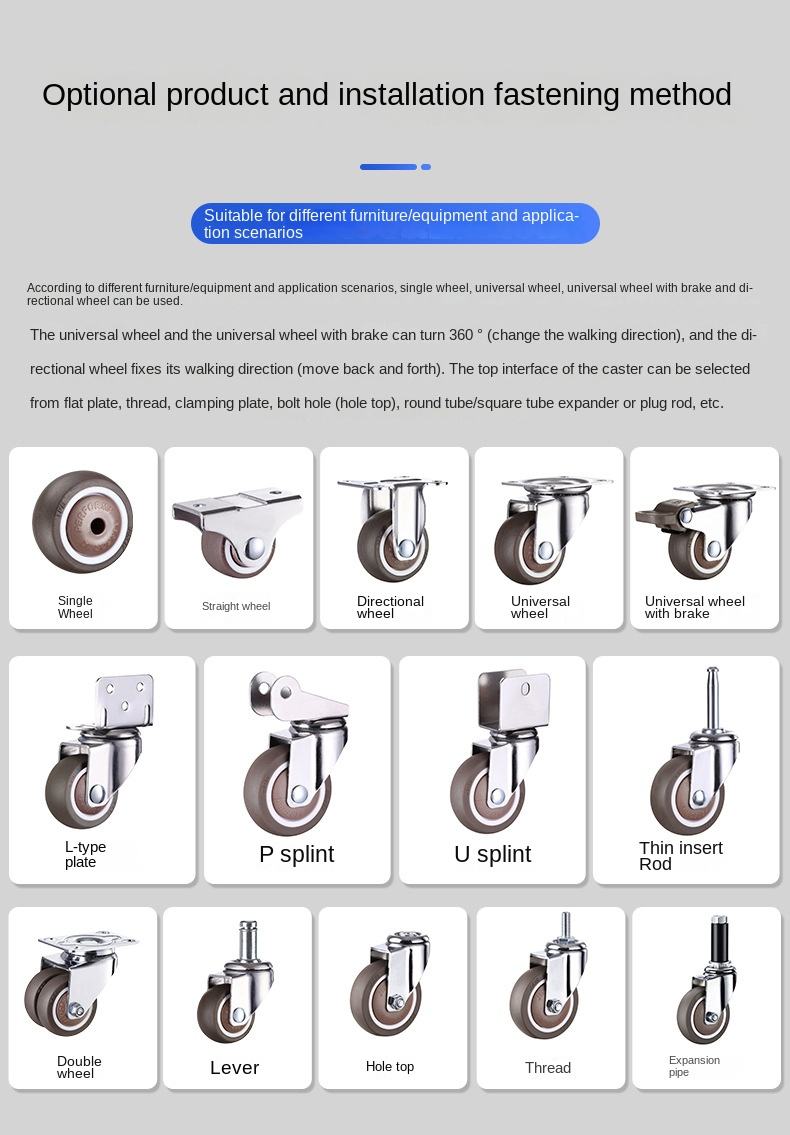
Floor damage is another common hidden trouble ignored by most caster users. Hard plastic and ordinary iron wheels produce strong scratching pressure on epoxy floors, cement floors and anti-static workshop grounds during high-load movement. Long-term rolling causes uneven grooves, cracked ground layers and increased cleaning and repair expenses. Premium polyurethane heavy-duty casters feature soft, shock-absorbing wheel surfaces that protect workshop floors while maintaining strong load resistance, reducing daily maintenance costs across the entire production line.
Shock resistance and steering flexibility directly affect work efficiency and labor intensity. Traditional casters easily jam, shake and deviate direction when moving heavy objects on uneven ground, slopes and bumpy passages. Workers spend extra physical strength adjusting directions repeatedly, slowing down handling speed and raising the risk of collision and tipping accidents. Optimized double-bearing rotating structures greatly reduce rotational resistance, achieve flexible 360-degree steering, stable direction control and smooth walking even under full heavy-load status.
Corrosion resistance, temperature adaptability and environmental tolerance determine whether casters can adapt to harsh working scenarios. Wet workshops, chemical processing areas, low-temperature warehouses and high-temperature production environments all test wheel material stability. Common casters harden and crack in cold weather, soften and stick to the ground at high temperatures, and corrode rapidly when exposed to oil, acid and alkali substances. Reliable heavy-duty industrial casters use chemically stable PU materials, resisting oil corrosion, moisture erosion and wide temperature fluctuations to maintain consistent performance in diverse complex environments.
Performance Comparison of Different Heavy-Duty Industrial Caster Materials
| Wheel Material | Load Bearing Capacity | Wear Resistance | Floor Protection | Noise Level | Temperature Adaptability | Applicable Scenarios |
|---|---|---|---|---|---|---|
| Ordinary Rubber | Medium | Poor | Average | High | -20℃~60℃ | Light indoor handling, flat clean ground |
| Nylon Plastic | High | Average | Poor | Medium | -10℃~80℃ | Dry flat ground, ordinary heavy equipment |
| Cast Iron | Extremely High | Poor | Very Poor | Extremely High | -30℃~120℃ | Outdoor rough ground, ultra-heavy fixed transfer |
| High-Density Polyurethane | Ultra High | Excellent | Excellent | Low | -35℃~90℃ | Warehouses, precision workshops, heavy machinery, frequent frequent mobile handling |
Most hidden failures of industrial casters originate from unreasonable brake configuration matching. Unidirectional simple brakes cannot lock stably on slopes and inclined roads, leading to equipment sliding, accidental displacement and safety incidents. Brakeless casters also cannot control walking speed during downhill transportation, bringing huge hidden dangers to personnel and goods safety. Full-lock double brake systems integrate directional locking and wheel rotation locking, keeping equipment fixed firmly in any position and greatly improving on-site operation safety standards.
Long-term frequent rolling will cause looseness of caster fixing bolts and shaft wear. Unreinforced brackets are prone to deformation and fracture under repeated impact vibration, forcing enterprises to stop production for replacement and maintenance. Standard heavy-duty casters adopt thickened integrated stamping brackets, reinforced fixed holes and high-strength bearing shafts, with tight assembly structure and no looseness after long-time high-frequency operation. This effectively reduces production downtime losses and repetitive procurement costs.
Overall operating cost control is the core demand of long-term enterprise operation. Cheap inferior casters seem low in initial purchase price, but require frequent replacement, floor repair, labor maintenance and accident loss compensation. High-quality heavy-duty industrial casters have ultra-long service life, low wear loss and almost no additional maintenance work. In the whole life cycle, the comprehensive use cost is far lower than low-quality substitute products, bringing continuous economic benefits to warehouse logistics and factory production management.
Choosing qualified heavy-duty industrial casters is not a simple accessory purchase, but a key link to optimize workshop safety, improve handling efficiency and reduce comprehensive operating costs. By solving hidden problems such as insufficient load, poor wear resistance, floor damage, inflexible steering and weak environmental adaptability, professional industrial casters build stable guarantee for continuous and efficient operation of various industrial handling equipment. Reasonable caster matching directly upgrades the overall safety level and operation efficiency of the whole production and logistics system.